

I had a great week! I’m very pleased with how much I got accomplished. Work on my website quieted down for a bit, and a few teaching sessions got canceled, so I was able to spend a lot of time on bridge.
I played a robot duplicate and reviewed a VuGraph segment pretty much every day. I’ve been mostly kibitzing Steve Weinstein in these VuGraph sessions, and he’s been incredibly generous with his time answering my questions.
Here’s one where I was proud of my analysis of the hand, but I did something different from Steve because my brain is still so matchpoint oriented.
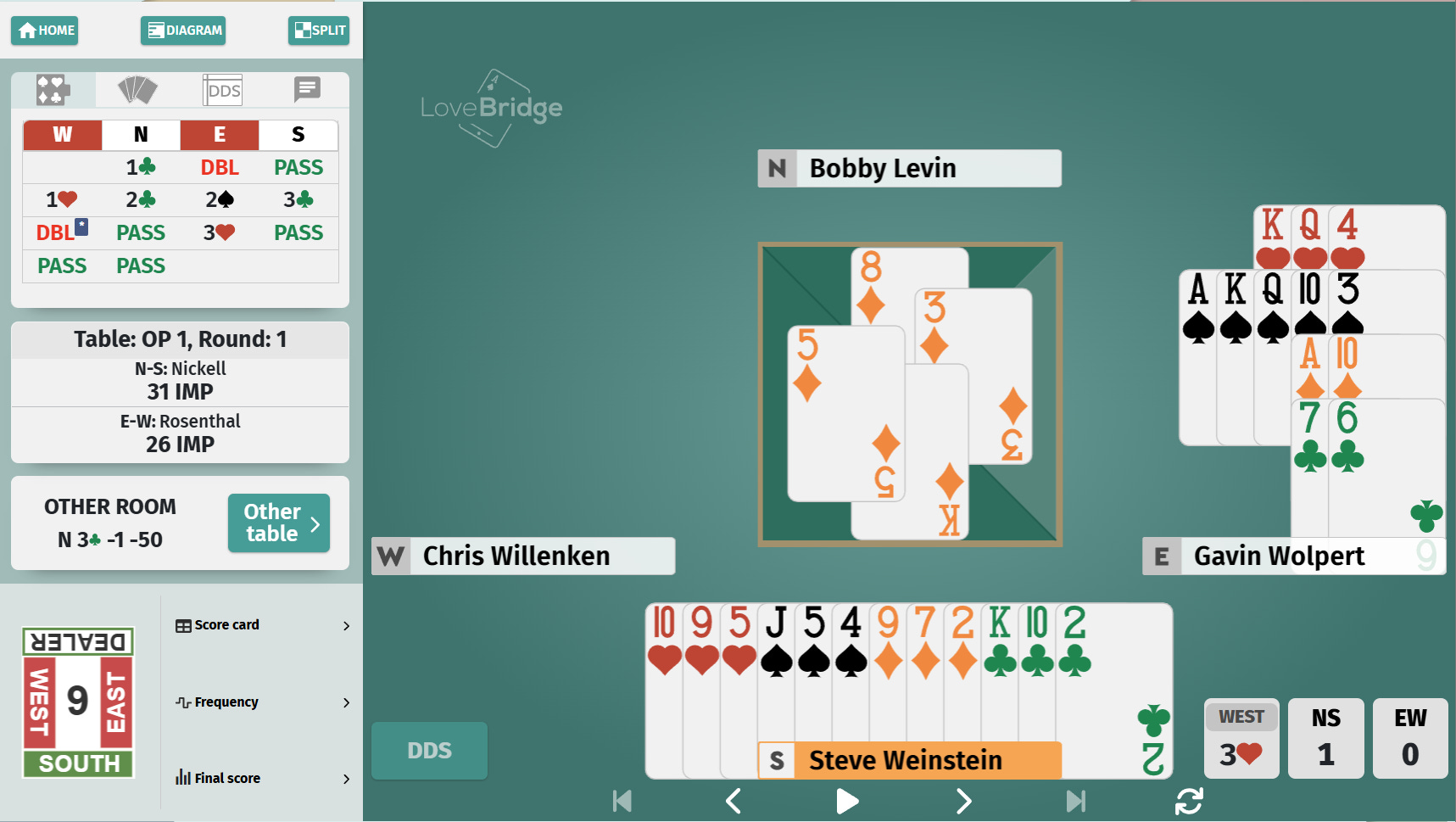
I put declarer on 2542, figuring he was 2-5 in the majors for the double, and that with 2551 he would have bid 3♦. And I didn’t think he would have ducked the diamond with 5 diamonds, fearing the ruff. And with spades 3-3, he was going to be able to pitch a club immediately if I returned diamonds, hoping against hope that partner had led a singleton. So I shifted to a club.
That’s my matchpoint brain thinking. I was right about the shape of the hand, but with that layout the contract is cold. The club shift might prevent an overtrick, but at IMPs the goal is to set the contract. As Steve said in his reply, he knew a club was hopeless. A diamond probably was, too, but at least it had a chance.
I can feel myself slowing down and playing better. Analyzing the hands more deeply, taking inferences I wasn’t taking the time to consider. Recording videos as I play the tournaments has been especially helpful in this regard—when I have to explain my thinking, I have to actually think! Now it’s developing the habit when I’m not talking it through out loud.
A theme I am hearing as I talk to great players is that getting the most of your game at the table is as important—probably more important—than actual bridge skill. This is true not just for the elite players, but for everyone. How often do you find yourself saying, “I can’t believe I did something that stupid” after a board? We all have that one board—or two or three—every session that we wish we could have back. We miscounted keycards, we didn’t pay attention to the vulnerability. At the expert level, it might be that we missed a spot card or didn’t take an important inference. One of the things that sets the great players apart is their consistency—they’re always at the table ready to play their best, and they don’t make mindless mistakes.
So just concentrate and don’t make mistakes! It sounds a lot easier than it is. Training yourself to do this is the work of a lifetime. A subscriber shared something from Zia’s new book with me that really resonated. He says that all players have some mechanism to help them focus on the hand in front of them. “The method doesn’t matter, just find what works best for you. I often start the next hand with the thought, ‘This is the hand that will decide the event, be ready.’” Treat every hand like it’s the one that matters. Easier said than done, but that’s the right attitude.
Here’s what I did this week:
VuGraph
I studied five more segments of the 2024 USBC. I’m really getting a lot out of this and recommend it highly.
Robots
I played instant tournaments on BBO pretty much every day this week. I also started doing Bridge Master, which had always been part of the plan, but somehow I had forgotten about it. I can only take that in small doses, but I’ll do a couple of hands when I have ten minutes to spare. I’m starting on Level 3, and I’ll work my way up.
Play
I played one duplicate game with a student over the weekend. Greg and I played a practice session on Thursday night. We’re planning to do this every week. I’m going to be streaming these practice sessions on Twitch most weeks; I encourage you to watch and ask questions/give comments. I forgot to turn on the “record” option—I’m still new to this streaming thing!—so last week’s session has disappeared into the ether. Hopefully it will record next time and it will be available for later viewing if you can’t make it live.
I had been doing a lot of my “review” in the moment. I was updating my spreadsheet between rounds when I played a duplicate game. I was looking through the last board when playing a match with Greg. I tried a different approach this week, that I think worked a lot better. I limited my analysis during the event, and really tried to focus all my concentration on what was happening at the table. I closed all my other browser windows to prevent the temptation of distraction. I take notes for my student while we’re playing, but I didn’t take time to analyze my own game. The next day, I went back and reviewed each board and made a note of places I was unhappy with my decision. I flagged a bunch of bidding situations to discuss with Greg. As I suspected, the discipline of the analysis was at least as valuable as the time playing.
Reading
I’m most of the way through Method Bridge. The first part of the book is all about thinking in terms of shapes—4432, 5431, 5332. It’s nothing I didn’t already know, but I have found myself repeating the shapes out loud to myself as I play, which I think has been helpful. Excited to keep reading it. I’m also enjoying The Inner Game of Tennis. I’m a tennis player, so it’s really fascinating on that level. But I think a lot of it translates to bridge.
Partnership
Greg and I played a practice match on Thursday night. We’re doing a pretty thorough revamping of our notes before Memphis. We spent about three hours on Saturday and got through page 15! There will be a lot more in the next three weeks.
In the past, we’ve had the philosophy of keeping the notes as light and streamlined as possible. It’s hard to trudge through a hundred pages of notes before every session. But if you leave something out of the notes, you need to be 110% sure you both know it and will remember it.
We had one of these come up in Hawaii. We play 3-level jump-shifts by responder as natural and invitational by an unpassed hand. Pretty normal agreement. I don’t even think we had that written down, but if we did, that was the extent of it. I’m sure we have discussed that if opener rebids their suit it’s to play, and anything else is game forcing. But it’s not in the notes.
I was also sure we had discussed responder’s maximum holding in opener’s major: usually a singleton, could be a small doubleton, never honor-doubleton. Lo and behold, Greg bid 3♥ over my 1♠ opening with Qx in spades. Either we never had the discussion and I was assuming this was “standard” or we had it years ago and, because it was never written down, we were on different pages.
So new philosophy: write stuff down! There has to be a line somewhere. We don’t really need to discuss our responses to Stayman, or write down that opener has to pass after 1NT-3NT. We’re working on a way to keep the notes complete, while not also unreadably long and dense. We’d like to have a shorter extract version with just the “need to remember this” stuff. It’s still a work in progress. Any suggestions would be appreciated.
Beyond Bridge
I gave away a lot of my mid-week concert tickets so that I can focus on my bridge training. But I still need to enjoy New York! I saw plays on Friday night and Sunday afternoon. It’s good to remind myself why I live here.
Walking, meditating, staying hydrated, and eating well are all going well. I wanted a healthy snack and bought some nuts. I forgot how good peanuts are! Now I’m eating too many of them. But at least that’s better than processed junk.
I encourage you to share your progress in the comments. We’re all in this together!!
Have a great week.
We use highlighting to provide for a quick skim of "what we need to remember". Anything that goes in new starts highlighted, and we remove the highlight after we're both sure we have it down. If there's something one of us wants to make sure we note every time we review the notes it just stays highlighted.
My team finished second in the GNT qualifying yesterday. The team that won were 4 younger guys that found games that we didn't. We learned that we need to improve some of our processes if we are going to compete at that higher level. It's hard when you're older to make changes, but we recognize our shortcomings and hopefully we can learn to make the changes that are needed.
Gary Kamin