

Greetings from Massachusetts. My family has a tradition of getting together for Columbus Day weekend and closing down the Cape house for the winter. It’s bittersweet, but it’s always nice to be together.
I flew up Friday—JetBlue’s seasonal flight from JFK to Hyannis is still operating—and am flying home tonight if the weather allows There’s a nor’easter raging around me (which is just New England speak for a big storm). Fortunately it’s not cold enough for it to be a snow storm. Delta has a daily flight from Worcester—which is much closer to my sister’s house than Boston Logan airport or the train station—to LaGuardia. I’m a Delta loyalist (Diamond Medallion member!), so I’m excited by this new option. This is my first time trying it, so fingers crossed.
I played in my district’s NAP game last weekend. I was playing with a new partner, Lucy Zhang, who recently aged out of the juniors and has been in NYC for a few years. She’s a great player and we had a good time. We finished fifth, just a few matchpoints out from qualifying to go to the national finals. That’s not bad for an unpracticed partnership, but it’s close enough that the mistakes are extra frustrating. And I made a couple of doozies in the second session. One I chalk up to being a little rusty playing in person.
Unfavorable vulnerability, partner opens 1♣, RHO passes, and you hold ♠ AQJ8 ♥ J5432 ♦ KT ♣ 42. So you bid 1♥ and partner rebids 1NT. Now you look down at your hand and realize those two little clubs are actually spades. Your hand is ♠ AQJ842 ♥ J5432 ♦ KT ♣ —
Shoot! Is there any way to recover? Maybe if partner has 3 hearts 4♥ won’t be worse than 4♠? This isn’t a situation the textbooks cover. Perhaps I should just pass and not dig the hole deeper. Everyone else is likely getting to 4♠, which is probably out of reach for me. Maybe it will go down and I can salvage the board with a plus score in 1NT.
I decided to try to match their +620 and forced to game with 2♦ and heard 3♣. Great. I tried 3♠, not really having much of a plan, and heard 4♥. Well, it was a place to stop. It just wasn’t a good one.
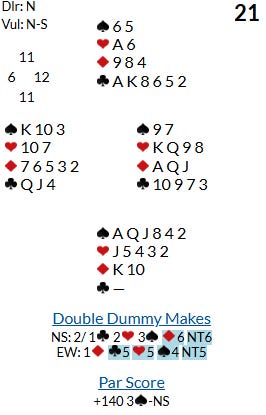
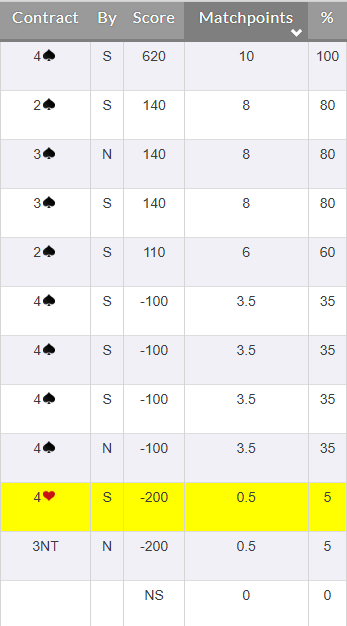
Passing 1NT might have salvaged an almost average board.
Obviously it’s not worth spending much time contemplating how to bid hands where you have 6-5 in the majors and responded 1♥. But having some general principles for situations like this, where you are in trouble and just hoping to salvage a few matchpoints, seems useful. What do you all think—what should I have done once I realized my mistake?
I had a pretty productive week, though I didn’t get as much VuGraph study in as I had planned. Greg and I have moved our weekly practice session from Thursday mornings to Friday mornings, because Thursdays is one of my days at the gym. I’m confined by their class schedule, and Greg was accommodating. But I was on a plane Friday morning, so we didn’t get our practice in and still haven’t gone through our COP—Cut Or Practice—review of the notes. Next week! Still, lots of Cuebids practice.
I started reading a new book this week: I Fought the Law of Total Tricks by Mike Lawrence and Anders Wirgren. It’s basically a challenge to Larry Cohen’s To Bid or Not to Bid about the Law of Total Tricks, which was a seminal book for me as I was learning about competitive bidding. My mind is being blown a little bit by Lawrence and Wirgren’s analysis of how often the Law is wrong and how one should evaluate in competitive auctions. To be fair, Larry published a sequel, Following the Law, that discussed some of the adjustments needed in order to get the most out of the Law. But it’s disorienting to find out that the basics of the Law—that the total number of tricks equals the total number of trumps—is right less than 50% of the time. Did everyone know about this and I’m just finding out now?!?
I’m about halfway through; I’ll let you know how it turns out!
Have a great week!
1N might be worse than 1H. I suggest rebidding 2H.
I created and delivered a lesson on I Fougt the Law many years ago. Yes, you may be the only good player who did not know about the Law, or rather, the Hypothesis' limitations.
Bruce