

It was an ugly, rainy week here in New York City. All the better for staying in and studying bridge! It cleared up by the weekend and was gorgeous. That’s spring in the Northeast.
Greg and I played a few games and did some work on our notes. I’ve continued my review of the Trials Vugraph. I’m continuing my morning habit of reading first thing with a pot of tea.
This was a bidding problem that I found interesting. You are in fourth seat unfavorable. It goes Pass-Pass-1♠ and you hold ♠ K532 ♥ AQT4 ♦ AJ ♣ J54. What do you do?
The field was split between Pass, Double, and 1NT. I passed. I’m solid with my 1NT overcalls, especially vulnerable and when partner is a passed hand. The risks outweigh the benefits. Responder has a penalty double, which makes overcalling more dangerous. I don’t care for the offshape double. Interesting that so many of the experts in the Trials acted, while the majority on Bridge Winners passed. I wonder if this is a bias between at-the-table decisions and posed-as-a-bidding-problem decisions.
This was a big loss for us, thanks to a great play by newly minted Hall of Famer Marty Fleisher. You can click through the play here.
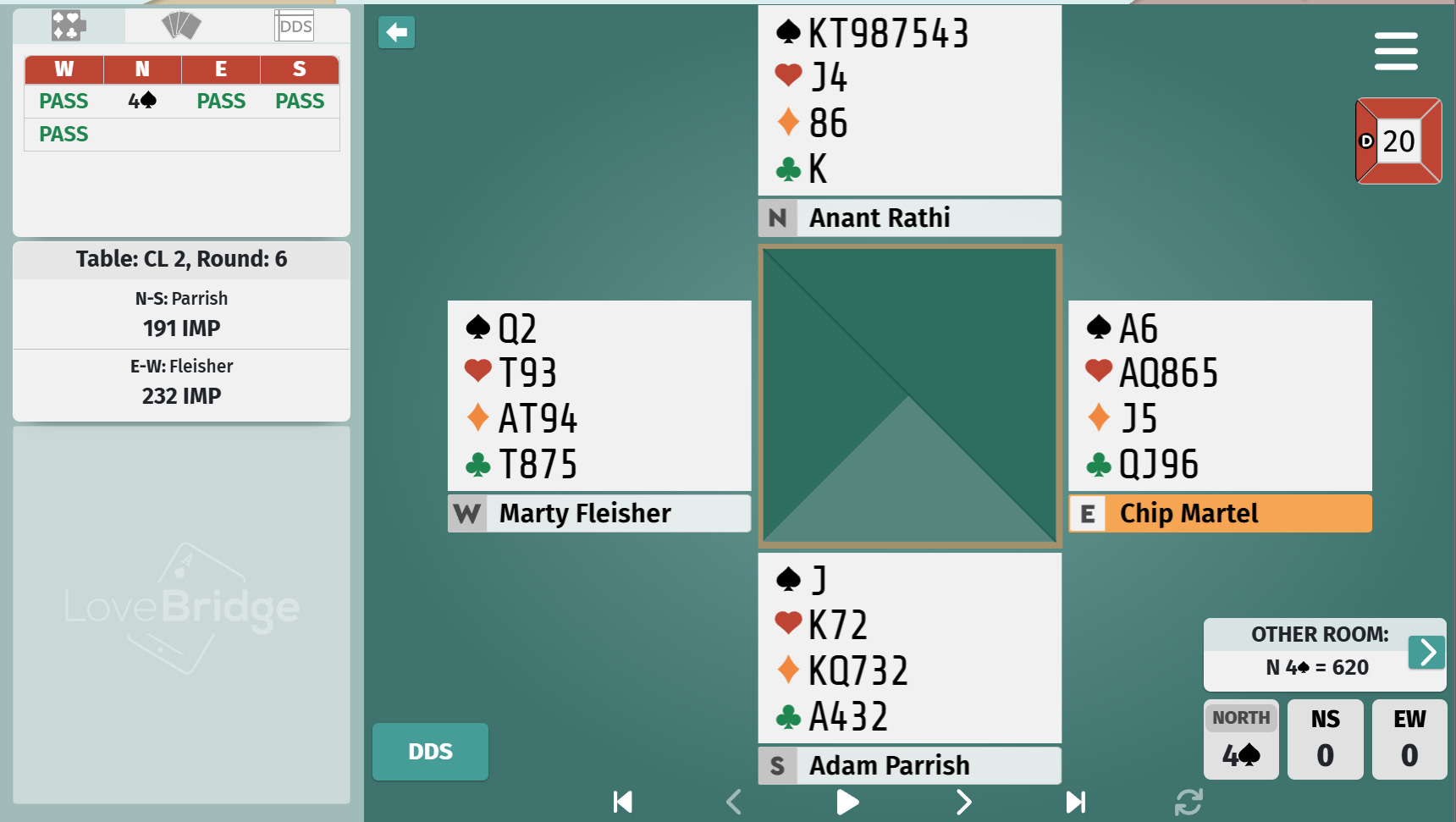
Most Norths opened 4♠. (You can see what happened on the board at every table here.) The play started the same at every table: East led a high club, declarer won and led a diamond. There were some divergences at this point. Marty and Chip found the best defense at our table: heart shift, take the ♥ A (at some tables East ducked, and declarer threw their losing heart on the ♣ A). East sticks declarer in the dummy and they lead the ♠ J.
At most tables, West covered with the queen, and declarer had no problem losing only 1 trump and making the contract. At our table, Marty ducked, giving Anant a very hard problem.
Marty was my roommate, and he had been planning what to do when that ♠ J got played from the beginning of the hand, so his low spade was in perfect tempo. Anant was in the tank for a while, so Marty and I talked about the position. He knew ducking could be a mistake, if declarer had something like king-ten-seventh without the 9. Now it goes jack-small-small-ace, the queen falls under the king, and the ten is high. If you cover, it goes jack-queen-king-ace, and partner scores their 9. But given that he was vulnerable in second seat, Marty put him on an 8-card suit, and the only one that really mattered was this one: king-ten-eigth.
What is the right play for declarer? Obviously on this layout you want to play low. If West has Qxx and East a singleton ace, your play doesn’t matter; you’re always losing 2 spades. The relevant holdings are this one; its inverse, where West has Ax and East Qx; and when East has a singleton queen. This one and the inverse are equally likely. In fact, the inverse is more likely, since West will often cover with Qx. Add in the singleton queen with East, and the king is definitely the right play.
It's a great example of a great player foreseeing his problem and backing his judgement, even though he knew it could be costly. Well done, Marty.
I encourage you to share your progress in the comments. We’re all in this together!!
Have a great week.
I'm a relatively new subscriber. What is "Trials Vugraph" you are reviewing?